If you run a small business or create content for a living, your bio is working as an employee: it greets every visitor, answers the first question and points them to the next step. Yet many business bios say things like “Passionate about quality” or “Making dreams come true”, which tell nobody what is for sale. A simple formula fixes that.
The one-line formula
Use this structure:
I help [who] [get what result] with [your method or product]. [What to do next].
You can reorder it, but all four pieces should be present: the person, the result, the method and the action.
Examples across six professions
- Home baker: “Custom birthday cakes for families in Leeds. Orders open every Monday. Message to book ↓”
- Maths tutor: “I help GCSE students raise their grades with weekly one-to-one sessions. Free trial lesson below.”
- Wedding photographer: “Relaxed, natural wedding photography across the north of England. Check dates in the link.”
- Personal trainer: “Strength plans for beginners over 40, delivered by app. First week free.”
- Freelance illustrator: “Children’s book illustrations with warm colours and gentle humour. Commissions open.”
- Plant seller: “Easy houseplants for dark flats, shipped with care instructions. New stock on Fridays.”
Each answer is concrete. A visitor knows in seconds whether this is for them.
Add one proof point
A short piece of evidence builds trust faster than adjectives. Choose something true and checkable:
- “12 years teaching”
- “200+ weddings photographed”
- “Featured in a local market guide”
- “Rated 4.9 by clients” (only if the ratings are real and visible somewhere)
Do not claim “number one” or “best” unless you can back it up. Misleading claims damage trust and can break advertising rules in some countries.
Include the practical bits
People often leave because they cannot find the basics. Check that your profile shows:
- Location or service area, if you serve a local market.
- Contact method. A working link, a booking page or an email that you actually read.
- Opening times or order rhythm, if you work in batches.
- Name consistency. Use the same business name and handle on all platforms.
Where to use decoration
It is fine to add personality, but protect the searchable parts. People find businesses by typing words such as “wedding photographer” or “houseplants”, and fancy Unicode letters will not match those searches. Keep your service words in plain letters, and use a symbol or a single styled word as an accent. Our guide on YouTube channel names and About sections explains the same principle for channels.
Make it fit each platform
- Instagram: use line breaks and stay within 150 characters. See the Instagram bio layout guide.
- TikTok: with 80 characters, keep only the promise and one action.
- Telegram or channels: write the audience, benefit and posting rhythm, as shown in our Telegram description guide.
Mistakes to avoid
- Writing about yourself only. Visitors care what you can do for them.
- Hiding the offer. If it takes a scroll to find what you sell, the bio failed.
- Using jargon. “Bespoke solutions” means little. “Wedding cakes” means something.
- Leaving the link dead. Test your link every month.
A five-minute rewrite
Take your current bio and underline the words that tell a stranger what you offer. If there are fewer than five, rewrite it using the formula. Then read it aloud and remove any phrase that you would never say in conversation. Test it on someone who does not know your business. If they can tell you what you sell, you have done the job.
If you run a Facebook page, the Facebook fonts generator previews your text as a post and counts the short intro bio, which helps you fit the one-line formula. Use style lightly, and for wording inspiration visit the bio ideas page before adapting each idea to your own business.
Turn features into outcomes
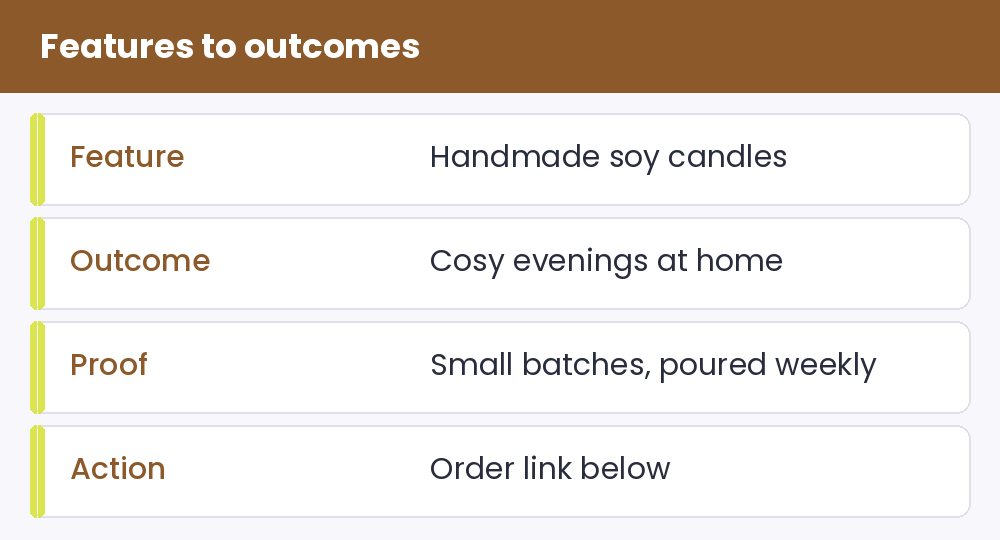
Customers rarely buy a feature. They buy what the feature does for their life. “Handmade soy candles” describes a product, while “Cosy evenings at home” describes the result. The best bios combine both, using the feature as proof and the outcome as the reason to care.
A simple test: read your bio and ask “so what?” after every phrase. If you cannot answer, the phrase is probably describing you instead of helping the customer. Replace it with a benefit, a number or a detail someone could check.
Keep your link and contact details tidy
Choose one main link and make sure it works on a phone. A page that loads slowly or asks for too many steps loses visitors who were ready to act. If you offer several things, point to one page that lists them rather than cramming several links into your bio.
Write opening hours or the next action in plain letters, because customers copy and search these details. Fix capitalisation of product names with the case converter, brainstorm phrasing on the bio ideas page and, if you run a page, preview a decorated intro on the Facebook fonts generator.