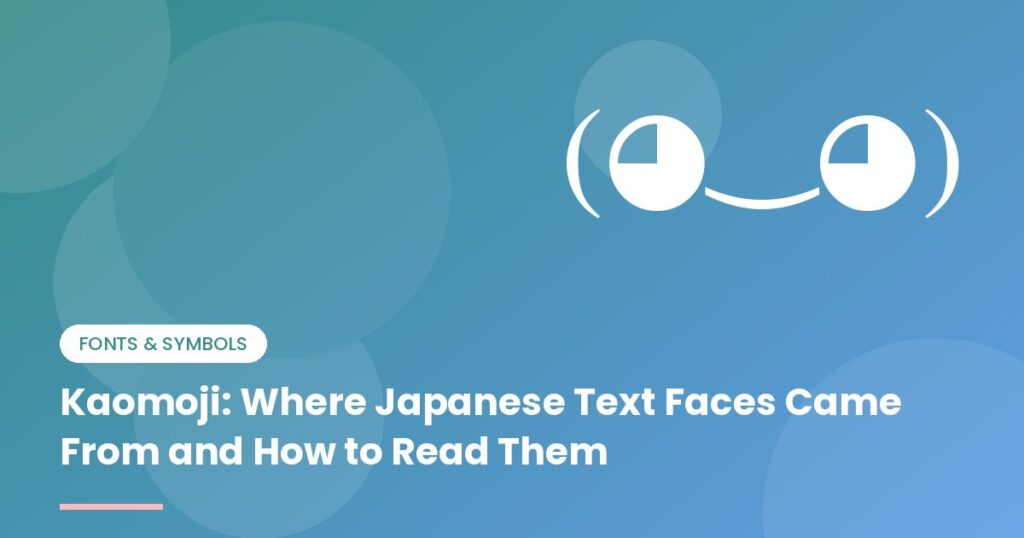
Western emoticons such as 🙂 ask you to tilt your head to the left. Kaomoji, the text faces that came out of Japan, do not. They are read upright, and they use a wide range of characters to show a surprising range of feelings. If you have ever wondered how (◕‿◕) is built or why some faces include arms and sparkles, this guide explains it.
What the word means
The word kaomoji combines two Japanese words: “kao”, meaning face, and “moji”, meaning character or letter. So a kaomoji is simply a face made of characters. They grew popular in Japanese online communities during the 1990s, where users wanted a way to express emotion in plain text. Because Japanese writing already uses several scripts and many symbols, creators had a big toolbox to draw from.
The anatomy of a face
Most kaomoji are built from a few predictable parts:
- Brackets or parentheses form the outline of the face, as in ( ) or ʕ ʔ.
- Eyes set the feeling. Round eyes like ◕ look innocent, carets like ^ ^ look happy, and ಥ looks like crying.
- The mouth often sits in the middle. The curve ‿ is a smile, ω gives a cat-like mouth, and _ is flat and neutral.
- Cheeks and marks such as blush lines or hearts add emotion.
- Arms and hands are drawn with characters like ヽ and ノ, which suggest waving or cheering.
- Extras such as ✧, ♡ or ★ add sparkle and mood.
Take (◕‿◕). It has round open eyes, a gentle smile and no extras, so it reads as sweet and friendly. Now picture ヽ(◕‿◕)ノ, the same face with raised arms. The meaning shifts to a cheerful wave.
Mood families
- Happy: open eyes, upturned mouths, small sparkles.
- Love: hearts, blush marks and soft eyes.
- Sad: teardrop shaped marks, trembling mouths.
- Angry: sharp eyebrows, gritted mouths, flipping tables.
- Confused: question marks, shrugs, sideways glances.
- Animals: bears, cats and rabbits drawn with ears and noses.
Our kaomoji collection is organised by these moods, so you can choose the right one quickly.
Using them well
- One per message. A single face has impact. A row of ten becomes noise.
- Match the tone. A cheerful face next to a serious message can seem careless.
- Place them at the end. Like a punctuation mark, a kaomoji usually closes the sentence.
- Know your audience. Friends and communities that enjoy online culture will love them. A formal email is the wrong place.
Technical notes
Kaomoji borrow characters from many scripts, including Japanese kana, Greek, Cyrillic and mathematical symbols. This variety is what makes them expressive, but it also means a rare character may show as an empty box on an older device. If a face matters, check it on another phone. The reasons are explained in our guide on empty boxes.
Another point is that backslashes and certain symbols can be altered by messaging apps that treat them as formatting. For example, the famous shrug looks right in some apps and loses its arm in others. If that happens, try pasting it as plain text or inside a code block where the app supports one.
Make your own
You do not have to copy faces. Start with an outline, pick a pair of eyes, add a mouth and decorate. Try changing only one part at a time. If you swap the mouth in (^_^) for a wavy one, you get a different personality. After a few experiments you will recognise the building blocks everywhere. To explore related characters such as arrows and shapes that appear in many faces, see our symbols collection, and for the difference between text faces and colourful pictures, read emoji vs symbols.
Read five faces at a glance

Reading kaomoji gets easy once you learn to start with the eyes. A face with caret eyes, (^_^), smiles. Two letter Ts for eyes, (T_T), show tears. Greater-than and less-than signs, (>_<), look like a squeezed face and show frustration or strain. A face with a small angled line over each eye, (¬_¬), gives a sceptical side-eye.
Once you know that pattern, new faces rarely confuse you. Check the eyes first, then the mouth, then any extra parts such as arms or sweat drops.
Culture note: eyes versus tilted heads
Western emoticons such as 🙂 are read by tilting your head sideways, and the mouth carries the mood. Japanese kaomoji face you directly and put the mood in the eyes, which allows much richer expressions. That difference explains why kaomoji can show shyness, joy and exhaustion with the same mouth.
Use them where a gentle tone helps, such as thank-you notes or friendly replies. Add a little colour with a heart from the emoji page, or explore pictures made of lines on the ASCII art page. The kaomoji collection sorts faces by mood so you can find the right eyes fast.
Other things people wonder about kaomoji
Are kaomoji and emoticons the same thing? They share a purpose but not a style. Western emoticons are short and read sideways, while kaomoji are wider and read upright.
Why do some kaomoji lose parts in messages? Chat apps may treat backslashes, asterisks or underscores as formatting marks, which removes or changes those characters.